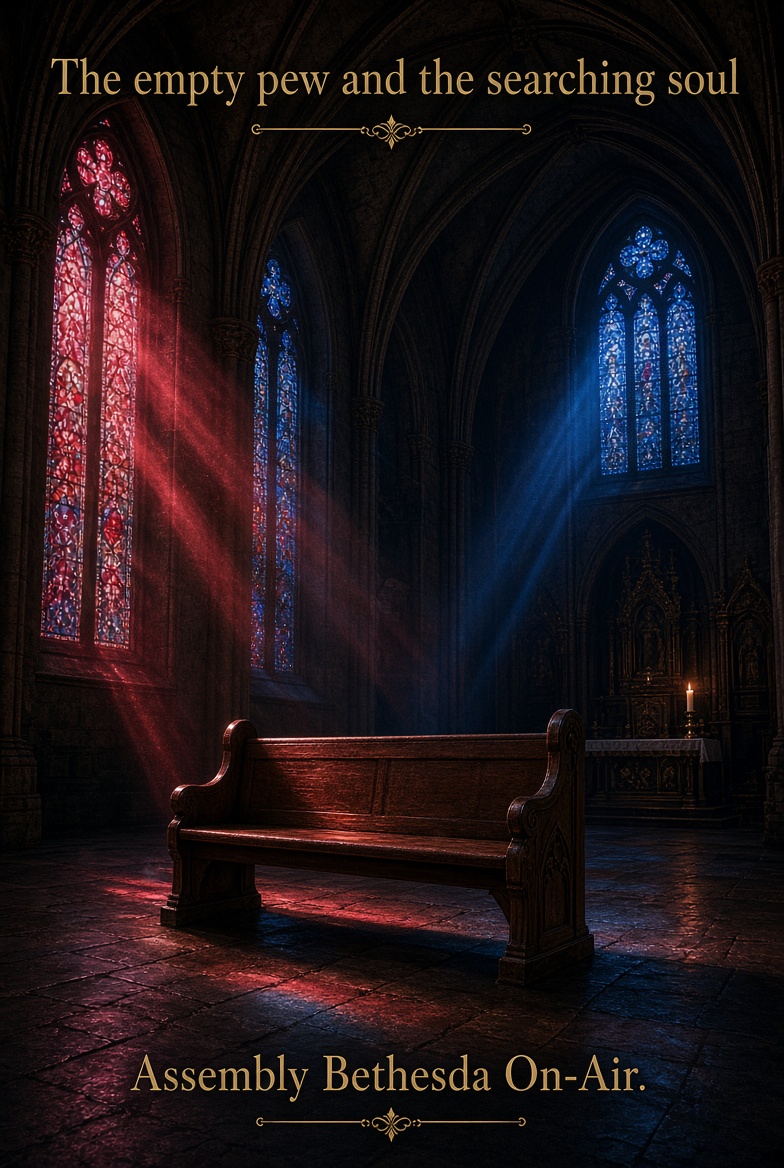
The empty pew sits in the quiet hush of an old stone sanctuary like a question mark carved in oak in the quiet hush of an old stone sanctuary. Under the high vaulted ceilings, stained glass catches the last of the afternoon light, turning it into deep crimson and sapphire pools on the floor. It smells like beeswax and old hymnals. One candle flickers near the altar, its small flame steady against the fading dusk. Searching souls often find themselves here, drawn by a restlessness the world outside can’t quell.
A vacant pew isn’t an accusation. It’s an invitation written in silence. It doesn’t shout. It just remains, steady and patient, while the heart that has wandered far begins to feel the pull of something older and truer than the noises. The Christian Gothic church isn’t just a stone and timber building. It’s a thin place where the veil between the seen and the unseen becomes thin, and the empty seat becomes a mirror. This song reflects the ache so many people feel, the sense that something essential is missing, that the soul was made for more than endless screens and constant demands.
Imagine walking the aisle for a while. The Gothic imagination loves details like this because it reminds us that faith isn’t abstract. It’s embodied. The light falls in slanted bars across the worn wood. It’s in the weight of a wooden pew, the coolness of stone under the hand, the way incense used to rise slowly toward the rafters. The searching soul doesn’t need clever arguments first. In order to hear the quieter voice that has been speaking all along, it needs a place to sit and be still.
It’s the same voice that once called across stormy water, the same voice that said peace in a locked room on Easter morning. It doesn’t require perfection before entry. It just says come. The empty pew is proof that the invitation is still open. Despite all the wrong turns, no one has taken the seat that was made for the one who’s still on the road, still wrestling, still wondering if belonging is possible.
It’s the architecture itself that’s so impressive. Flying buttresses lean inward like it’s being held together by strength bigger than its weight. Rose windows bloom with color even on gray days. These forms weren’t just meant to impress the eye. They were meant to lift the heart, to train the gaze heavenward while keeping the feet firmly on earth. In the same way the empty pew trains the soul to look up while it sits down. The posture of trust is rest, not surrender to despair.
The searching soul often carries a quiet grief for the distance it feels. It remembers childhood faith or the faith of parents and grandparents, and it wonders whether that warmth can still be found. The empty pew doesn’t scold the memory. It accepts it. The God who met the child is the same God that waits for the adult. There’s no need for the seeker to know everything before he sits down. The only thing it asks is honesty, the willingness to bring the questions into the light.
There’s room for both shadow and light in a Christian Gothic mood. The shadows aren’t evil, they just make the light come out in contrast. The searching soul knows those shadows well. The empty pew has walked through seasons of doubt, silence that felt like abandonment, and prayers that bounced back from a closed sky. It’s a gentle contradiction to the lie that no one’s waiting. Someone’s always waiting. When the seeker finally shows up, the One who filled the first empty tomb fills the seats with presence.
Imagine when the door opens and the seeker steps in. The latch sounds soft. Steps echo a little. Then the settling into the wood, the release of the shoulders, the slow breath that reaches the bottom of the lungs. This simple act renews something ancient. There’s the communion of saints, the great cloud of witnesses, the living Body that stretches across centuries, and they all lean close to you. There was never an empty pew. The love that doesn’t grow impatient held it open.
The searching soul doesn’t get lost beyond recall. It’s just still traveling. The road may have been long and the night may have felt endless, but there is still light in the sanctuary. Candles near the altar continue to work quietly. Stained glass keeps breaking the ordinary daylight into glory. Oak pews keep waiting like oak has already endured many seasons of weather.
It’s hard to explain how beautiful Christian Gothic is. It doesn’t try to polish away the darkness or pretend that life is always bright. It just looks at the empty spaces and sees the shape of longing itself. Longing isn’t a failure. It’s the soul remembering its true home. The empty pew is a physical manifestation of it. It’s the place where the ache can finally rest without having to explain itself.
Here’s the invitation: come as you are. Bring the questions, the weariness, the half-formed prayers. Sit in the quiet and let it do its work. The high ceilings will open your eyes. The colored light will soften the hard edges of the day. The solid wood will hold you up. Searching souls may discover in the stillness that they’ve been found all along, held by love that never left the room, never locked the door, never stopped keeping the seat open.
You don’t have to worry about the empty pew. It’s just there’s room for the next traveler. There’s room for the next question. It’s room for the next quiet yes that comes from a heart that’s finally stopped running. Those yes’s enough in the Gothic nave. It’s the beginning of belonging, the first note of a hymn that’s been waiting to be sung for decades. You don’t have to search forever, there’s a seat ready. It’s still dark. It’s still open. Come and sit. As slowly as the sun settles over old stone and the candle flame holds steady against the dark, the rest will follow.