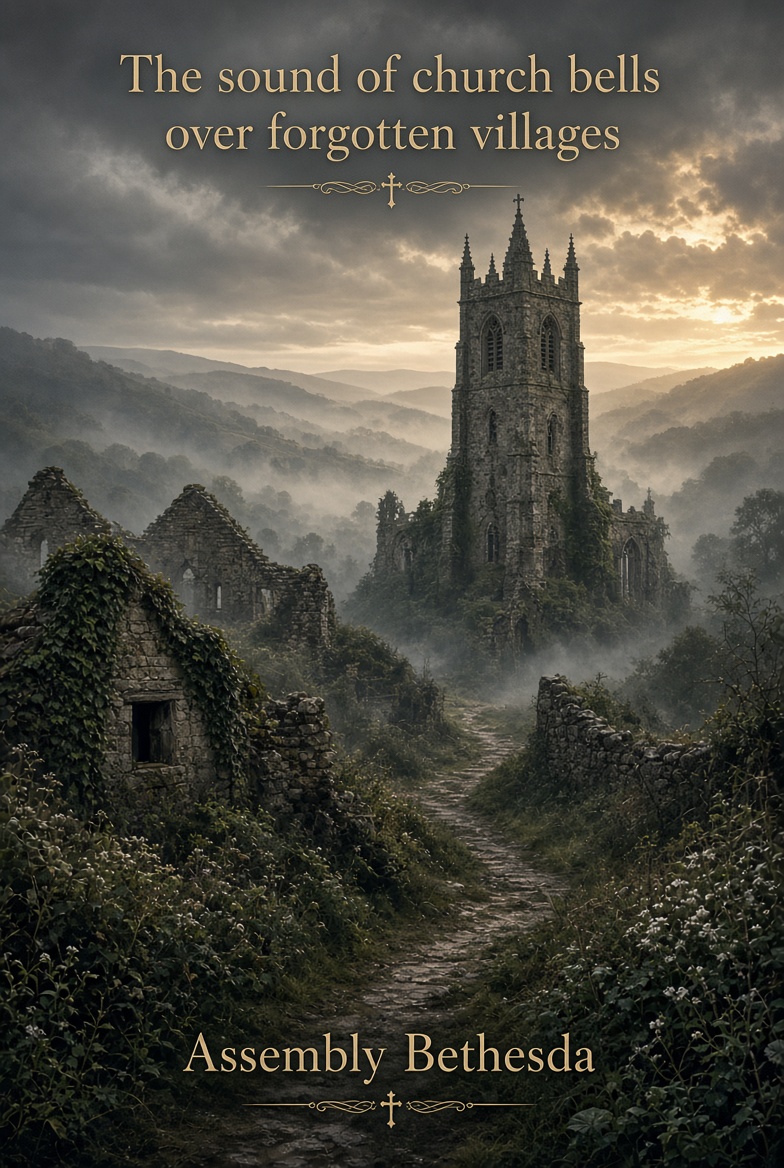
The sound of church bells rises once more in the quiet folds of the countryside where stone walls lean under the weight of years and ivy claims what time left behind. It drifts over forgotten villages, those places marked by empty windows and paths thick with grass. The bells don’t ask permission. They just sound, pure and steady, cutting through mist and memories.
These villages stand as silent witnesses. Roofs are sagging, doors are open to the wind, and market squares are empty, but the tower remains. The stones, though weathered, keep their place. We hear the familiar call, the measured ring that once marked prayer hours, seasons of the year, and turning lives toward God.
There’s no haste in that carriage. It moves across fields left fallow, over streams that still run, through woods that have reclaimed the edges of old lanes. The bells speak of a presence that doesn’t leave the ground it once consecrated. They speak of permanence in a world that shifts.
Christian Gothic sensibility finds its home here, not in the gloom of despair, but in the solemn beauty of what endures. It’s all about the broken walls, the moss on the steps, the silence between the peals. It’s a reminder of God’s call. The call keeps going even after people leave.
Whenever you listen closely, you can see the pattern. The clapper hits the bronze in a way that reminds you of the Cross, the empty tomb, and the promise that lies beyond the visible. Though the villages are forgotten by maps and by travelers, the One who made the heavens doesn’t forget them. The bells tell you that.
In the early light the sound is sharp, almost bright, like the metal itself remembers the hands that hung it. At night, it softens, blending in with distant cattle lowings or birds chirping back home. The tower always returns to its center, to the faith that raised it. The faith wasn’t meant just for the prosperous. Every place, every season, every soul that still breathes under the sun, deserves it.
The Gothic note sounds in the contrast. Beauty and decay stand side by side. The saints on the doorway are worn smooth by rain, but still turn their faces toward heaven. Cracked stained glass still catches the light and scatters it across the floor. There’s nothing hidden. The ruin is honest. In that honesty, the bells can be heard at their loudest.
They call the living to remember the dead, the present to honor the past, the wanderer to pause. They call the heart back to its first love, the love that once filled these villages with song and sacrament. Baptisms were a sign of new beginnings and funerals were a sign of hope for the faithful. The bells commemorated all those moments. They mark the spot where those moments once lived, and they keep the memory alive by doing so.
You don’t need crowded pews to make it sacred. In the absence of human voices, the bronze still speaks. Even if the footsteps don’t cross the threshold, the air still calls. Don’t forget. The door isn’t locked. The path is still there, even if it’s overgrown. Come. Come back.
Despite the villages sleeping, they aren’t abandoned. The bells keep watch. In Christian imagination, this isn’t tragedy. The sound is a form of prayer that doesn’t need a congregation, a liturgy that continues regardless of whether anyone cares. The sound of faithfulness itself rings out across the hills, refusing to be quieted by time.
If you think about the metal that the bells were cast from, it was once ore in the earth, then fire in the forge, then shape and tone by hand. That process mirrors the soul’s own journey, refined by trial, shaped by grace, set in place to give voice to something bigger than itself. Bells don’t ring just for their own sake. The bells ring to draw people upwards, outwards, and inwards to God, who is present in both the sound and the silence.
The peal becomes a kind of benediction over forgotten villages. It blesses the empty houses, the untilled fields, the lonely roads. It blesses the memory of those who once lived there and the possibility of those who might yet return. It blesses the land itself, letting us all know that God cares for every place.
The Gothic quality lies in the atmosphere of solemn wonder. Shadows lengthen early in these valleys. Fog settles in the hollows. Stones hold the cold of many winters. Yet the bells cut through all of it with a clarity that feels almost supernatural. They don’t deny the darkness. But they don’t let it win.
There’s a sound that doesn’t depend on circumstances. It’s the sound of a kingdom that’s not of this world, but claims every corner of it. The sound of church bells over forgotten villages is the sound of hope that doesn’t depend on circumstances. This is the sound of Christ still calling, still present, still Lord of the ruined and the restored.
We should let the bells ring. Let them roll across the hills and settle in the bones of the land. Let them remind everyone that the Church is not just the gathering of the living, but the communion of all the faithful, past and present. Truth sometimes shines the brightest in forgotten places. God remains. The call continues. The sound endures.
The villages aren’t silent, even if they’re quiet. Through the bells, they still talk. Through the bells, they still pray. Through the bells, they continue to witness the One who’s still the same yesterday, today, and forever. That’s the beauty in the silence. This is the Christian Gothic truth that rises with every peal and settles with every fade into the evening.
Next time the wind carries that familiar tone across an empty landscape, pause. Listen. It’s the same message as always. Come home. The door stands open. The bells still know how to get there.