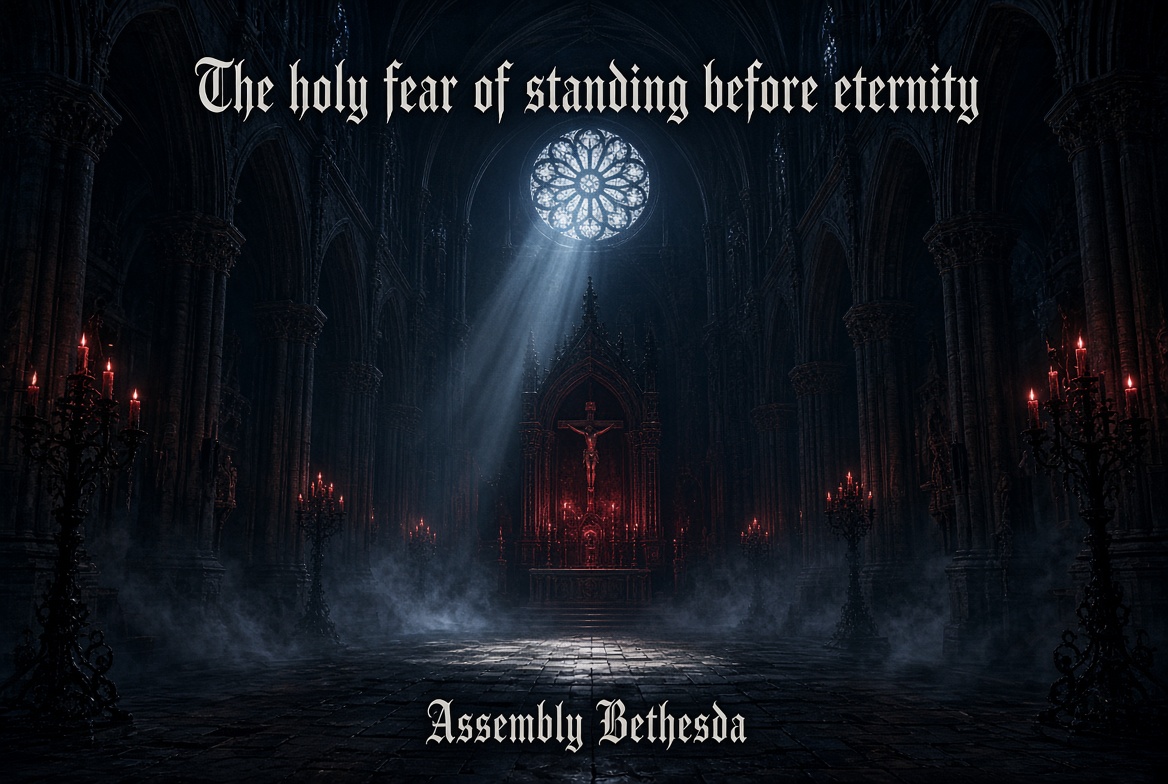
Whenever we stand at the edge of the veil, where time frays and eternity presses close, holy fear rises not as terror that flees, but as trembling that draws closer to us. Every breath counts, every secret thought has already been laid bare before the One who has always existed. It’s a dark-winged sentinel guarding the heart from casual and profane in the shadowed halls of Christian Gothic contemplation.
At midnight, imagine the cathedral surrounded by gloom, candle flames shivering in the cold. Standing in front of eternity isn’t a distant future event, it’s a present reality. The air itself seems thick with judgment and mercy intertwined with each other. Eternity doesn’t wait at the end of the road, it surrounds, it invades, and it claims. A finite creature’s response to the Infinite pressing against its thin membrane is holy fear.
It’s clear in Scripture that fear of the Lord is the beginning of wisdom, but it’s also the atmosphere we live in every day. Abraham fell on his face when the Almighty appeared. Moses hid his face at the burning bush. Isaiah cried out that he was undone in front of the Holy One. John fell like he was dead before the risen Christ, whose eyes were like flames. There wasn’t just fright, it was holy recognition. As the creature saw the Creator, the only fitting posture was reverence.
Christian Gothic paints this fear deep crimson and midnight black. It’s the blood of the Lamb. Against a stormy sky, the cross stands, the empty tomb still echoing with the silence of the grave that could not hold Him. Holy fear doesn’t deny sin, it stares into it until the horror itself becomes a doorway to grace. The soul that hasn’t trembled hasn’t really seen redemption’s cost. Nails, thorns, forsakenness, these aren’t soft symbols. They’re the price paid so sinners can stand, trembling but accepted, before the throne of God.
When morning light filters through stained glass, the first thought isn’t schedules or ambitions, but the Judge who sees. The tongue is guarded because everything will be weighed. The eye is turned away from vanity because the gaze of God is already fixed upon the heart. The hands are kept from injustice, because one day they’ll either bless or judge. Holy fear doesn’t mean paralysis, it means precision. It cuts away the frivolous and leaves only the good stuff.
Gothic souls love the contrast of shadow and light, the vaulted ceiling that lifts the eye, and the cold stone floor. It’s the tension of being both dust and destiny, both condemned and redeemed that believers learn to love. Eternity isn’t a gentle meadow of endless ease, it’s standing before a God who’s consuming fire and yet also whispering to you. Standing before such a God without fear would be foolish. True worship starts with holy fear.
There’s a lot of substitutes for this fear in the world. There’s the cheap thrill of a horror story that doesn’t lead to repentance. There’s sentimental piety, which softens every hard edge of Scripture until it’s just a cushion. It’s the proud intellectualism that dissects doctrine but never kneels. Against all these, the Gothic heart protests in silence. Let the fear stay. Let it be sharp. Let it be holy. It should drive the soul to the foot of the cross over and over again, not because it’s comfortable, but because it’s the only place the trembling can rest.
In the quiet hours, when the city sleeps and the wind moves through the trees like a distant choir, the soul may feel the nearness of eternity with particular force. The clock ticks, but it’s measured against the eternal. While the body ages, the spirit is enchanted by the undying. Holy fear is almost tangible at such times, a pressing pressure against the chest, a stillness that demands attention. It’s not morbidity. It’s clarity. Death is certain, judgment is certain, and mercy is offered now.
Saints in the old days walked in this fear and found it to be a lantern rather than a chain. They built cathedrals that soared toward heaven while their foundations rested on the ground. They wrote hymns that trembled with dread and delight. They faced martyrdom with a holy resolve that had already died to self. Their example continues. The same God who called them still calls. Every soul is destined for eternity like they were.
The modern believer needs to learn to tremble again. Not with the fear that casts out love, but with the fear that is perfected by it. The fear of punishment is cast out by perfect love, but the fear of majesty is not. In the presence of majesty, the soul can know it’s forgiven and still fall silent in awe. Christ’s blood covers every sin, yet the throne remains high and elevated.
A holy fear of eternity isn’t a burden to be discarded, it’s a gift to be received. It keeps the heart soft. It keeps the eyes open. It keeps the knees bent. When the final veil is drawn aside and the soul stands in the unmediated presence of the King, that fear won’t vanish; it’ll become pure adoration. It stays a faithful companion on the shadowed road, whispering that every step matters, every choice echos, every moment is already in God’s hands.
Then walk with this fear as a lantern. The Gothic night is long, but the morning of eternity is just around the corner. Let it shine a light on the dark places of your heart. Let it reveal the cracks where pride still hides. Let it drive you to the mercy seat where the blood will speak a better word to you. You’ll find that fear itself is praise until then, so stand in holy fear until then.