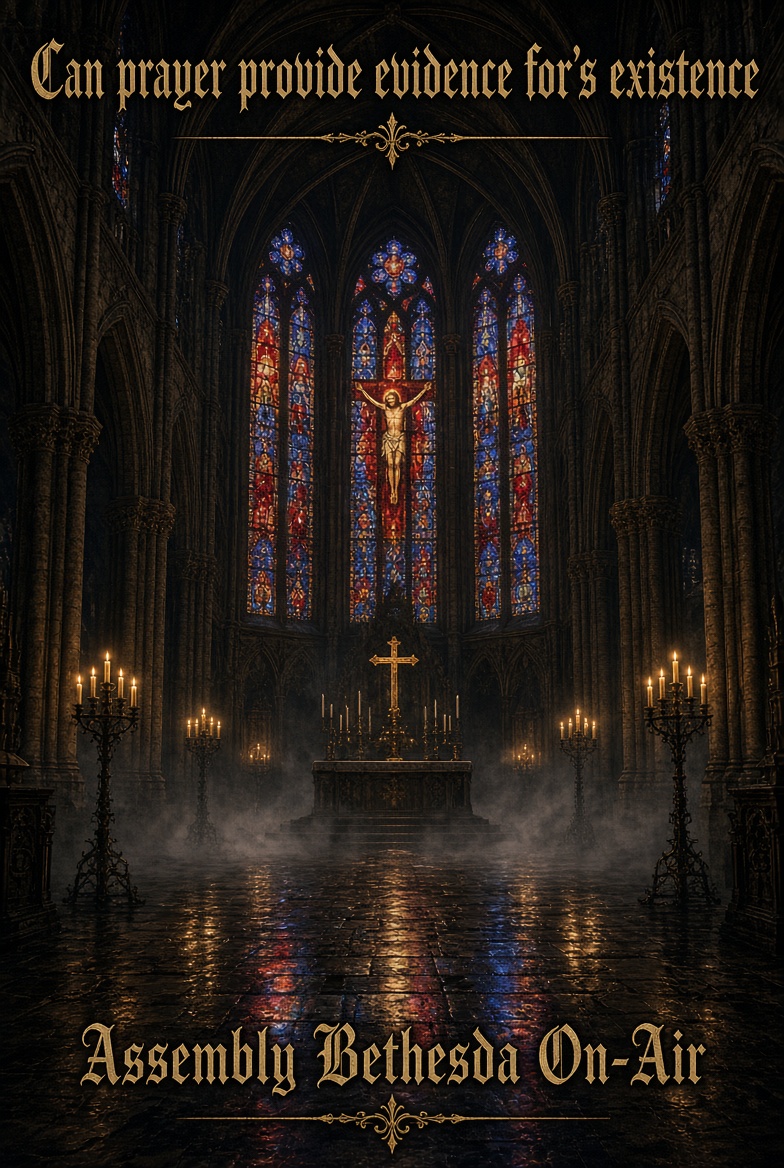
In the hush of an old cathedral where candlelight flickers against cold stone and stained glass throws colored shadows across the floor, a question lingers in the air like incense. Is prayer evidence that God exists? It’s not the kind of evidence that fits neatly in a lab notebook, but the kind that settles deep in the chest when the world outside feels heavy and distant. Christian Gothic faith is here, where mystery is not an enemy but a companion, where the sacred moves through darkness as surely as it does through light.
It’s the act of turning toward Someone who can’t be measured by instruments and yet answers in ways that rearrange the soul. You kneel or sit or simply stand with your eyes closed, and you speak, or you stay silent, and something shifts. Sometimes the shift isn’t dramatic. Sometimes it’s the sudden ease of a burden you thought would crush you. Sometimes it’s a clarity that doesn’t make sense. Often, it’s the feeling that you’re not speaking into an empty room. These moments add up. They form a pattern that can’t be ignored.
Think about the way prayer changes the one who prays. A heart that arrived clenched with fear often left softer. Anger that burned hot can cool into something closer to patience. Despair that felt absolute begins to fray. It doesn’t take a theological degree to do this. It just takes honesty. When people pray with sincerity, they feel the presence of others and close to them. This presence doesn’t always grant the exact request they say.
There’s something deeper it grants, a steadiness that lasts longer than the request. As time goes by, these steadinesses become their own kind of evidence. The conversation keeps reshaping you in ways random chance doesn’t. You start to trust this One because it keeps reshaping you.
The Gothic imagination understands this well. In the great stone churches, the architecture itself seems designed to remind the soul of its smallness and its dignity at the same time. This setting is perfect for prayer. It’s not bright, cheerful. It’s an encounter with mystery. Shadows gather in the corners, light filters through colored glass in broken patterns. The evidence isn’t a signed affidavit. It’s the fact that the questions don’t feel unanswered, even if they stay unresolved. You bring your questions, your grief, your longing, and you leave them in the presence of a God who is both hidden and revealed.
Some people claim prayer is just psychological comfort, a trick the mind plays on itself. There’s something neat about that explanation. It keeps the universe tidy, but it still doesn’t explain why prayer doesn’t comfort sometimes. There are times when the silence feels absolute, when the words rise and fall without any warm response. Those seasons are also part of the evidence. It’s not just a vending machine, it’s a relationship, too. The God who meets us in prayer isn’t obligated to perform on demand. There’s a mark of genuine otherness in his refusal to be controlled. A projection of his mind would be more accommodating. There’s nothing wrong with being quiet when it serves a bigger purpose.
The quiet evidence has been carried forward across centuries by ordinary believers. They’ve prayed in cathedrals and prison cells, in hospitals and kitchens, in moments of triumph and long nights of loss. They don’t all feel the same way. It’s the persistent sense that Someone is listening. This sense produces fruit. Communities form around it. Acts of mercy grow out of it. Courage appears where fear once lived. It’s the Gothic tradition that loves contrasts: light against darkness, hope against despair, the sacred rising out of human struggle. Prayer is where those contrasts meet.
A lifetime of prayer that forms character, softens hardness, and opens the heart to others becomes evidence, rather than instantaneous. One answered prayer might be chance, but a lifetime of prayer that slowly builds character, softens hardness, and opens the heart to others looks more meaningful. People who pray regularly often become more attentive, more patient, and more willing to forgive. Those aren’t trivial changes. They’re the kind of changes that don’t explain naturally. There’s something outside the closed system of the self at work. Christian faith calls it God.
Then there’s communal prayer. Whenever people pray together, there’s a new quality in the room. The sense of presence multiplies. After the amen, the shared silence can feel charged, as if the air itself has thickened with attention. Gothic worship has always understood the power of gathered voices under vaulted ceilings. Architecture amplifies human cry until it seems to touch heaven. That’s when the evidence isn’t private. It’s public. It’s a recognition that God’s presence is among us.
Doubt doesn’t get erased by prayer. It’s part of the Gothic landscape, the shadow that gives the light its shape. Faith that never questions becomes brittle. Faith that prays through the questions grows stronger. The evidence prayer offers isn’t the elimination of uncertainty. It’s just discovering that you can hold uncertainty in the presence of a God who’s bigger. Before you speak, don’t solve every philosophical riddle. Speaking itself becomes a form of knowing.
In the end, it comes down to the individual heart. Can prayer prove God exists? This isn’t a theorem, this is an invitation. Try it with honesty. Take the weight of your life and sit with it for a while. Take notice of what happens. Notice the subtle rearranging of your inner world. Take notice of when peace arrives without explanation. Watch for the gradual formation of a life that looks more like love and less like self-protection. As these notices accumulate, they form a kind of proof that the materialist framework can’t handle.
The Christian Gothic faith doesn’t fear the dark. It takes a candle called prayer and walks into the dark. It doesn’t abolish shadows, it just makes them easier to navigate. But after praying, the one who prays discovers that the path was never empty. They’ve been walking it with someone all along. That discovery, repeated over a lifetime, is enough for some. Maybe it’s enough for you too.
There are secrets in the stone walls, but the candle keeps burning. In the silence and the spoken word, the God who listens continues to answer in ways too deep for ordinary measurement. Prayer doesn’t just ask, it reveals. And what it reveals is a presence that won’t go away.