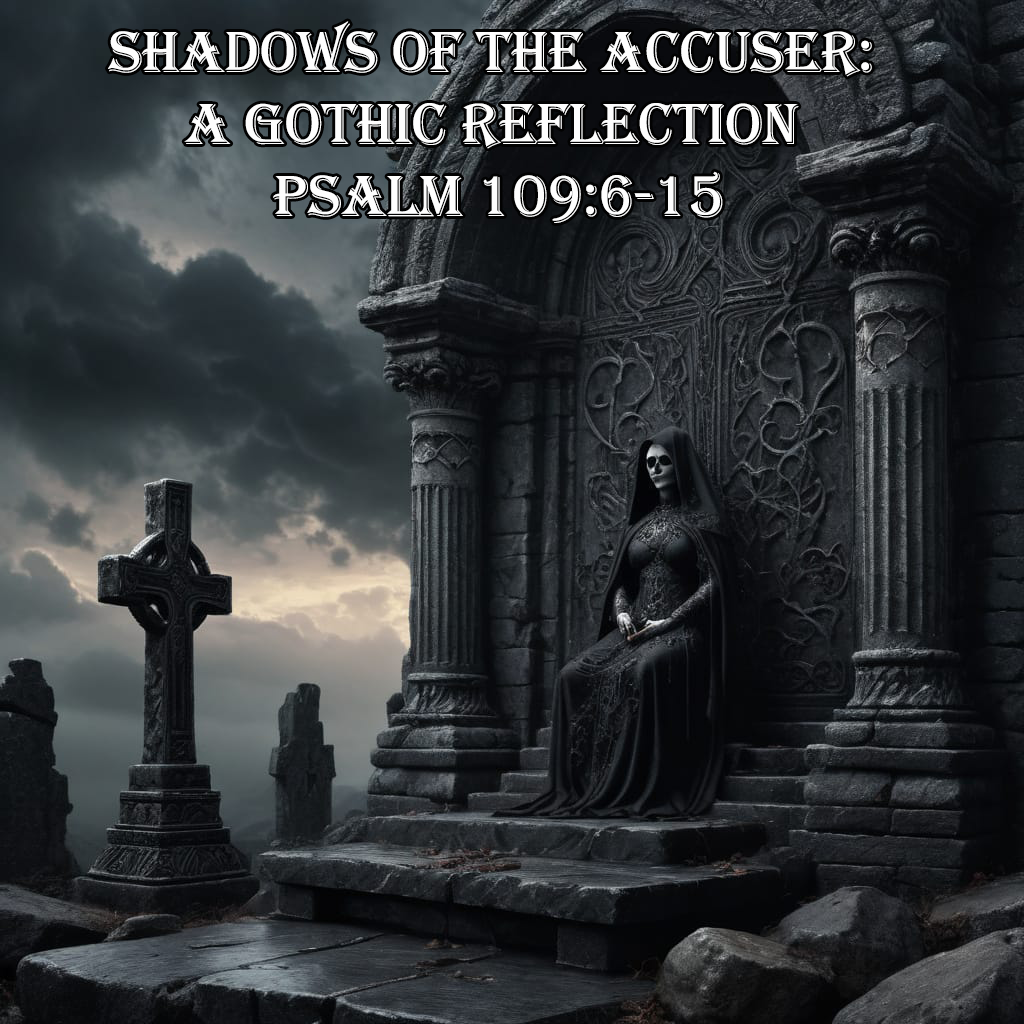
In the quiet corners where faith meets the night, Psalm 109:6-15 pulls back the veil on a prayer that feels heavy, raw, and unfiltered. These verses come from a heart under attack, screaming out to God about enemies who twist truth and spread lies. This isn’t a gentle psalm, it’s one that seeks justice straight out of the blue.
In exploring it through a Christian Gothic lens, we see how the words paint pictures of a God who doesn’t ignore people’s pain, of curses that highlight redemption, and of a God who doesn’t ignore light. Let’s talk casually about each part, like sitting under a dim lamp, drawing black lace curtains, and letting the words sink in without fancy explanations, just honest reflection on what they mean to our faith.
As the section opens, “Appoint someone evil to oppose my enemy, let an accuser stand at his right hand.” It’s like flipping the script on the accuser. The psalmist isn’t grabbing power himself, he’s laying the whole mess at God’s feet and asking the Lord to let the enemy’s own tactics back around.
In Gothic Christian terms, picture a lone figure in a long dark coat standing at the edge of a foggy graveyard, the wind whispering whispers about accountability. It’s not about us plotting revenge, it’s about trusting God sees every false word and every hidden scheme. There’s an accuser for every accuser, and that image feels both terrifying and fair because everyone gets the mirror of their actions.
Afterward, “When he’s tried, let him be found guilty, and let his prayers condemn him.” The prayer takes a sharp turn here, asking that even the enemy’s attempts to talk to God fall flat. Our Gothic faith makes you pause because it feels so final. Yet we understand it as part of the bigger picture of justice, where deceit cannot stay hidden forever.
It’s like an old courtroom lit by flickering candles, shadows dancing on stone walls, and a guilty verdict echoing through the night. As the heart behind prayers reveals itself, they serve as their own kind of judgment. We don’t rush past the discomfort of these words, we sit with them, because they show us how seriously God takes the harm he does to His kids.
As the psalm continues, “May his days be few, may another take his leadership position.” Everyone’s life is brief, but this plea asks for the wicked influence to end quickly so someone else can take it over. Almost like the crumbling of a grand, but rotten castle, it’s a call for change at the top. Gothic imagery is perfect here, with ivy covering broken towers and moonlight revealing what’s hidden. This isn’t a wish for endless suffering, but for the structures built on lies to crumble so truth can rise.
The verses move into the family line with, “May his children be fatherless and his wife a widow.” This part hits with real emotional depth, showing how one person’s choices ripple out and affect those around them. Gothic Christians don’t hide the sorrow in those images, the empty chair at the table, the widow’s veil, quiet rooms where laughter used to thrive.
It paints a portrait of loss that mirrors the pain the psalmist himself has experienced, yet it also shows how God cares for the fatherless and the widow in ways that the world can’t. Darkness here isn’t pointless, it emphasizes how sin leaves wreckage, and it invites us to believe in the one who rebuilds.
Continuing on, “May his children become wandering beggars, may they be driven from their ruined homes.” Now the scene shifts to displacement, kids begging on the streets, homes in ruin. These images feel straight out of a Gothic novel, abandoned estates with broken windows and wind blowing through empty halls. I like how these words show how injustice can scatter families and leave nothing but echoes in the wake. In the Gothic faith tradition, this reminds us that earthly security built on deceit won’t last, but the home we have in Christ won’t.
The psalm adds, “May a creditor seize all he has, may strangers plunder the fruit of his labor.” Everything you gain through crooked means gets taken back, strangers walking off with what you didn’t really deserve. There’s poetry to it, like the rich man suddenly has nothing while the humble get unexpected help. It’s God leveling the field, taking away false wealth to show what’s really worth. It reminds us to hold loosely to things that don’t last, and it shows the temporary nature of ill-gotten gains.
Also, no mercy is requested, “May no one show him kindness or take pity on his fatherless children.” The plea is to retaliate for the lack of compassion the enemy showed. The absence of kindness reveals the true state of the heart, even though it feels cold at first. Gothic Christian thought sees this intensity as part of the honest cry from someone who hasn’t been shown mercy. It’s all black and white, no softening the edges. That reminds us that God hears every unspoken pain and responds when it’s time.
“May his descendants be cut off, their names blotted out from the next generation.” Names carry memory and identity, so asking for them to be erased is asking for the whole line of harm to end. I’m picturing moss-covered tombstones, names worn away by time and weather. It’s a melancholy picture, beautiful in its finality, and it reminds me that only names in the Lamb’s book will endure. We don’t celebrate destruction here, but we acknowledge the cost of persistent evil and hope that future generations can break free.
“May the iniquity of his fathers be remembered before the Lord, may the sin of his mother never be blotted out.” Past wrongs are brought to light, not hidden or excused. In Gothic terms, it feels like lifting the veil on family secrets hiding in dusty attics. It’s a call for full accountability across generations. The Christian hope breaks through here because Jesus stepped into our family lines of sin and offered a new inheritance. The remembering isn’t about punishing ourselves, it’s about cleansing ourselves.
As it closes the section, it says, “May their sins always be before the Lord, so he can wipe their names off the earth.” The sins stay visible until they’re blotted out, and the contrast between what’s remembered and what’s erased is really striking. Gothic Christianity is about holding both judgment and mercy in the same place. Instead of leaving us in despair, these verses pull us through the shadows so we can see the cross more clearly, where Christ took every curse so we could receive blessings.
In this passage, there is a lot of darkness, intense language, and intense emotions. That’s why it fits so well with a Gothic kind of faith. All these things serve to highlight the light that refuses to be overcome, so we embrace the melancholy, the black veils of mourning for sin, and the crosses standing tall in stormy skies. Psalm 109:6-15 doesn’t give us easy answers or soft comfort, it gives us raw honesty that gets us closer to God’s heart. Our deepest pains and our strongest desires for justice are brought straight to the throne, and we trust He’ll handle them.
The curses sit right in the middle of worship, showing us that it’s okay to feel all of our feelings in faith, as we close this reflection. The curses are part of a larger psalm that starts with praise and ends with praise. We can tell God about the hurts we carry, the betrayals we face, and the longings we have for things to get better in our everyday lives.
In spite of the darkness, we can name it, describe it in all its Gothic glory, and then watch how the light of resurrection shines through it. It’s not the loud kind of courage that stands firm when everything else is falling apart, but the quiet steady kind.
Getting scripture this way keeps faith alive and honest. It lets the ancient words speak to us about our modern struggles without watering them down. These verses offer a place to stand, whether you’re drawn to black lace and silver crosses or just feel heavy and shadowy. They remind us that God isn’t distant from our pain, He enters it, He responds to it, and He redeems it. The shadows are real, so carry this portion of Psalm 109 with you, let its honesty fuel your prayers, and let its hope anchor your soul.