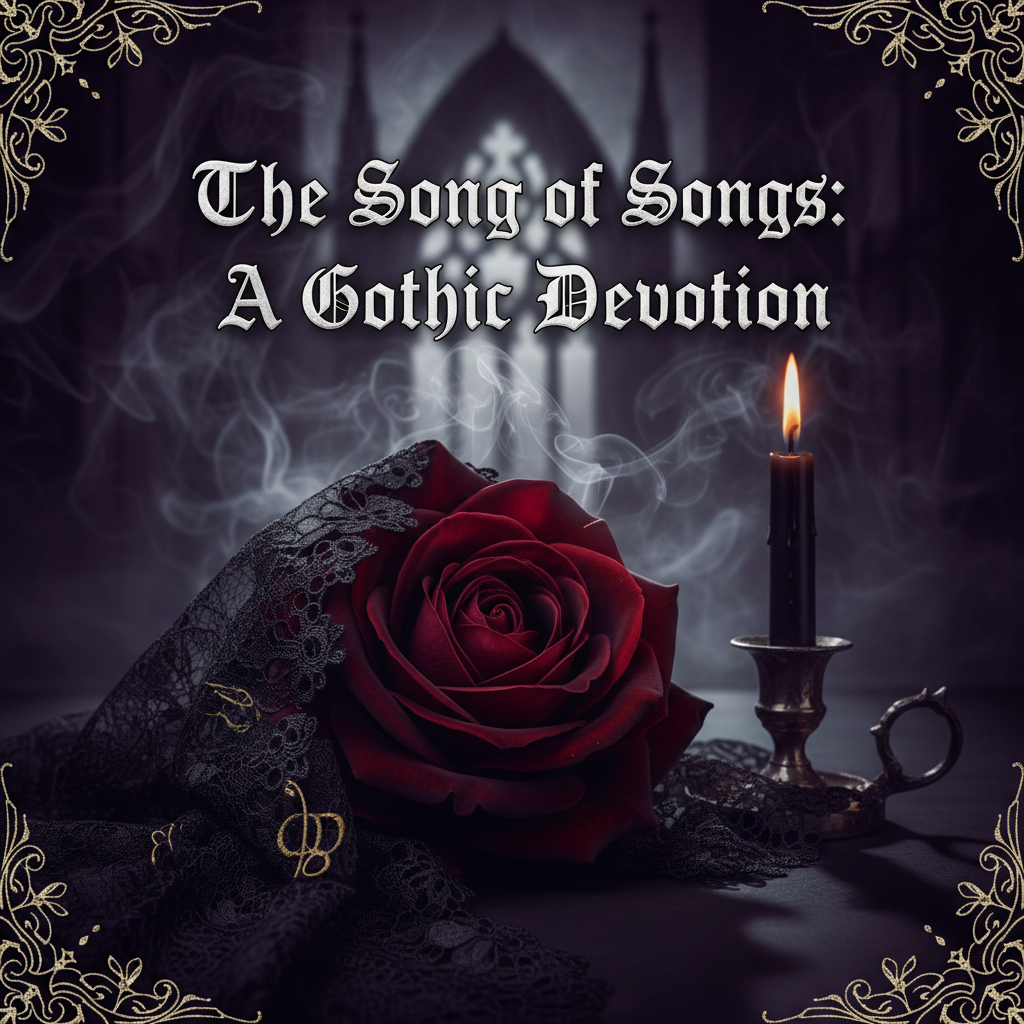
It’s one of those bible books that pulls you right in with its poetry and fire. It feels like a love letter written in the middle of the night, full of longing and beauty that doesn’t shy away from the shadows. We like this book because it shows how divine love thrives in the dark places, where passion burns hotter and hope rises from what looks like loss. It’s not some distant, polished story. Raw, intimate, and alive with the kind of romance that speaks straight to a melancholy heart that knows both grief and grace.
Right from the start, the bride cries out, let him kiss me with the kisses of his mouth for your love is better than wine. She’s not holding back. She wants closeness, the kind that sets the soul on fire. Then she says I’m black but pretty, o ye daughters of Jerusalem. It’s a line that hits a chord with anyone who has ever felt out of place in a big church. It means that even in our darkness, in our black lace, and quiet storms, we can still be lovely to God. Darkness doesn’t cancel out beauty. It frames it, it makes the light of Christ even more obvious.
It’s like a moonlit garden. She says she’s the rose of Sharon and the lily of the valleys. These aren’t hothouse flowers, they grow wild among the rocks and thorns, beautiful in their resilience. He calls her eyes doves and her hair like a flock of goats descending from the mountains. It’s poetic and vivid, painting a picture of love that takes notice of every detail, even if it seems insignificant to others. As Christians, we see this as Christ seeing the hidden elegance of the veiled soul, the strength hidden under the folds of black fabric, and the quiet endurance of the melancholy.
Throughout the poem, the bride searches for her beloved at night. As she walks through the city streets, she asks the watchmen if they’ve seen the man she loves. The dark night of the soul isn’t empty. It’s where we seek and learn to trust the voice that speaks from the shadows. The watchmen don’t help much at first, but she keeps going until she finds him and holds him fast. This is a reminder to keep going in the dark until you find the embrace you want.
The Gothic view says love has its own timing, and the timing often involves seasons of waiting that feel like endless twilight. So don’t stir up or awaken it until it pleases. She’s invited to go away with him to the mountains and hills where the foxes spoil the vines. Those little foxes are the little things that ruin the tender growth in our hearts, the doubts, the distractions, the quiet fears that nibble away at joy. We guard the garden of our faith with the same care, keeping the love alive even when it’s dark.
As the chapters progress, the descriptions get better and better. In Gothic Christianity, the soul is a hidden place where the beloved is the only one who can get into it. He calls her his garden enclosed, a spring shut up, a fountain sealed. Myrrh reminds us of the cross, the costly perfume that comes from surrender. The spices and myrrh fill the air. A heart that has been through fire and come out refined emits frankincense like prayer.
The ache is real when a bride dreams that her beloved knocks at the door and she hesitates for a moment, only to find him gone. She’s calling through the streets again, searching for him. It’s like the soul dances with Christ back and forth. Sometimes it feels like he’s close, sometimes it feels like he’s absent, but it never leaves us in despair. There’s always a reunion and celebration at the end.
The mutual love builds chapters after chapters until it reaches the powerful declaration that love is as strong as death, its jealousy as cruel as death’s grave. We see it flashes of fire, a fierce flame. It can’t be quenched by many waters, nor can it be drowned by floods. That’s the core truth of Gothic. Christ’s love is not fragile. It survives the grave, it outlasts the darkness, and it takes the bride out of her own sorrow and into resurrection. This verse is your anthem if you’ve ever felt buried under melancholy or burdened by a world that doesn’t understand your black clad devotion. Love wins, not despite, but through shadows.
It ends with the bride calling the beloved away, and the final seal is placed on the heart and on the arm. That seal is permanent. It marks us as belonging to the one whose love is better than life itself. Gothic terms describe it like the cross we wear close to our skin, the symbol that tells us this darkness isn’t over. Light paints its most vivid stories on it.
Throughout the Song of Songs we find a love that is both tender and fierce, intimate and cosmic. There’s no more veil between the bride and the bridegroom at the big wedding feast. It’s a great companion in the night watches for Christians who follow the Gothic path. The melancholy we feel in the quiet hours is a reflection of the eternal romance between Christ and his church, and our black clothes can be priestly robes.
The poetry invites us to linger in the garden, to listen for the voice of the one who calls us lovely even when we feel most unseen. It teaches us to speak back with the same honesty, to pour out our longing without shame. The Song of Songs reminds us that real love is messy and beautiful and worth every shadow it passes through, even if it’s in a world that often prefers neat and tidy faith. That’s the soundtrack for the soul that finds God at midnight, the soul that knows dawn always comes after the longest night.
It whispers that the beloved is near, that the garden is waiting, and that the love we chase in the dark is the same love that has already found us and won’t let us go.