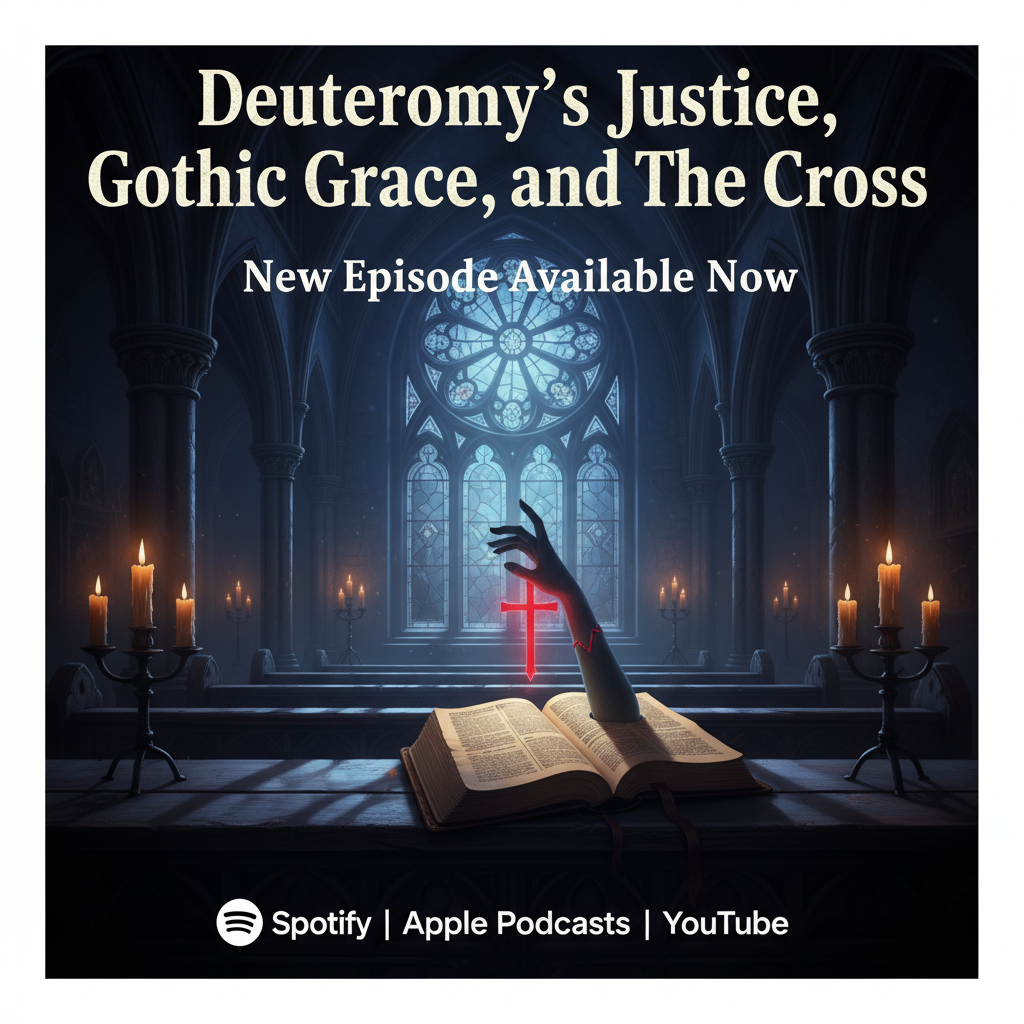
The old rules are heavy like midnight fog rolling over ancient stones in verses 11 and 12 of Deuteronomy 25 where the old rules feel heavy like midnight fog rolling over ancient stones in the quiet corners of scripture. If two men tangle in a brawl and the wife of one steps in to save her husband, then it’s clear. Take her hand off. Don’t show her any pity. That’s a tough parable, isn’t it? Old Testament justice wrapped in a severity that makes you wonder how a God of endless love could do something like this.
In spite of that, the Gothic soul of faith finds its pulse here, in the heart of that darkness. Picture it. The dust of the fight choking the air, the desperate clutch of a wife trying to save him, and then the blade of the law. In this scene, black lace veils hide tears and candlelight dances on cold marble. But this isn’t just punishment. A doorway to understanding how the law exposes our frailty, how human hands grasping in the wrong way reveal a deeper need for a savior who lets his own hands be pierced.
We should look at this verse with an open heart, like you might speak with someone over coffee in a dimly lit chapel when the candles are out. Deuteronomy is in the Torah, the five books that lay the foundation for God’s people. There are lots of rules in Chapter 25 for fairness in marriage, loans, and disputes. These aren’t abstract ideas. They’re street level instructions for a nation trying to live holy.
During verses 11 and 12, the wife intervenes, but she crosses a line by seizing the attacker in his most private spot. She’s sentenced to amputation, no pity shown. Why so harsh? That culture valued fatherhood for family lines and inheritance. A blow there could end a man’s future, so the wife’s move, even though it was out of love, made chaos and dishonor worse.
Still, the Gothic lens pulls us deeper into the symbolism. That hand reaching out in the fray becomes a symbol of every desperate grab we make when fear gets the best of us. Our hands cling to control, safety, and whatever we love to keep it safe, and sometimes we grab in ways that wound instead of heal. The law doesn’t wink at the violation. Cut it off mirrors the serious costs of sin. No half measures.
The Old Testament law is not the final word. It’s just the black canvas on which grace explodes. It demands justice, which feels cold, like iron gates slamming shut in an abandoned graveyard.
Consider how this fits into the bigger picture of redemption. Jesus himself talks about the law in Matthew 5, saying he came not to abolish it, but to fulfill it. Those sharp edges point directly to the cross, where the ultimate punishment falls on innocents. Those hands nailed open for us heal the hand that should’ve been severed for grasping wrongly. We see it all the time in Gothic Christian art: skulls resting at the foot of the cross, black roses blooming from thorns, torn veils. The severed hand of Deuteronomy symbolizes what we deserve, but Christ’s blood covers even that. The law doesn’t have mercy, but the new covenant has endless mercy.
In the melancholy beauty of it, we can linger. The fight in the dust reminds us that life is full of fights, literal or spiritual. Enemies press in, loved ones rush to defend, and hands reach places they shouldn’t. The law says stop, pay the price. Faith whispers that Jesus already paid it. It’s not about earning points or keeping rules exactly, it’s about resting in the truth that the darkness of judgment has been swallowed up by the light of resurrection. It’s like a Gothic anthem, doesn’t it? The shadows are real, the consequences are real, but they’re not the end of the story.
Expanding further, consider the cultural backdrop without getting lost in dusty textbooks. A woman’s role in ancient Israel was to protect the family line. A move like that disrupted God’s order for disputes. The punishment preserved dignity and prevented escalation. It wasn’t about hate. It was about upholding a standard in a world where survival depended on clear boundaries. Though we live in a different time, the principle still rings true. When we overstep in fear or anger, there are ripples. The Gothic heart doesn’t hide from this truth. It embraces the weight, wears it like a heavy velvet cloak, and then lays it at the foot of the cross.
Let’s look at the shadows we still face in life. Maybe you have troubles in your relationships or inside. It’s easy to grab control rather than trust God’s timing. The law reminds us the cost is high. Grace reminds us the bill’s paid. This balance keeps faith from becoming shallow. It keeps the Gothic edge sharp: hope dressed in mourning clothes, beauty in brokenness. The raw power of these verses is what draws the melancholic soul closer. We who walk with a taste for the dark know that true light only dazzles after the night has pressed in hard.
This theme runs throughout scripture. Look at the prophets crying out in ruined cities, their words dripping with judgment but yet laced with promises of restoration. Or David, who pours out honest pain before the throne. In Deuteronomy 25, God commands no mercy, but he also weeps over Jerusalem and gives out living water to outcasts. There’s a veiled figure kneeling at an altar, one hand extended in regret, the other resting on a blood-stained cross. The Blade of the Law has fallen, but the nail prints of Jesus have changed history.
There are more layers to this passage as we sit with it. Grabbing here attacks the future itself. God’s response protects that sacred spark. In Christian thought, it foreshadows how sin attacks the seed of promise, but Christ crushes the serpent’s head. The punishment, even though severe, safeguards the covenant. Grace fulfills: no more severed hands needed, because the perfect hand of Christ was offered instead. The grave couldn’t hold him, and law’s shadows couldn’t hold us either.
The old rule of showing no pity emphasizes divine justice’s perfection. Human courts waver, but God’s standards don’t. That unflinching gaze is terrifying in its purity, but comforting because it means evil won’t win. A Gothic worldview celebrates this tension. We light black candles and sing about both the valley of death and the table that awaits it. It’s a metaphor for anything we need to let go of to become free: pride, self-reliance, wrong defenses. Letting go hurts, but resurrection comes after.
Throughout the book of Hebrews, the old covenant fades in glory in the new, or in Revelation, when the lamb who was slain stands victorious in the midst of cosmic darkness, we could keep tracing these threads for pages more. Each connection adds depth without losing the casual heart of the message. This verse isn’t a club to beat anyone with. It’s a mirror showing our needs and a window showing God’s provision. As melancholy wraps around us like a shroud, these words remind us the shroud is temporary. The stone rolls away.
In Gothic Christianity, we don’t airbrush the hard stuff. We don’t skip the blood or the blade. We frame them in stained glass and set them to minor key melodies, so let Deuteronomy 25:11 12 sit heavy in your heart. Feel the weight. Then look at the one who took every cut, every penalty, every pit of despair. His love isn’t soft. It’s fierce, forged in the same fire that lit the law. Through that love, the severed hand is restored, the fight is won, and the darkness becomes the perfect backdrop for light.
It changes how we deal with our own battles. We act wisely instead of panicking. We trust the ultimate rescuer. We wear our faith like midnight velvet, modest yet bold, marked by crosses and hope. The ministry of Assembly Bethesda exists to hold space for exactly this kind of honest wrestling, where the goth heart and the Christian heart beat as one. Just honest talk about real scripture in a world that needs both justice and mercy.