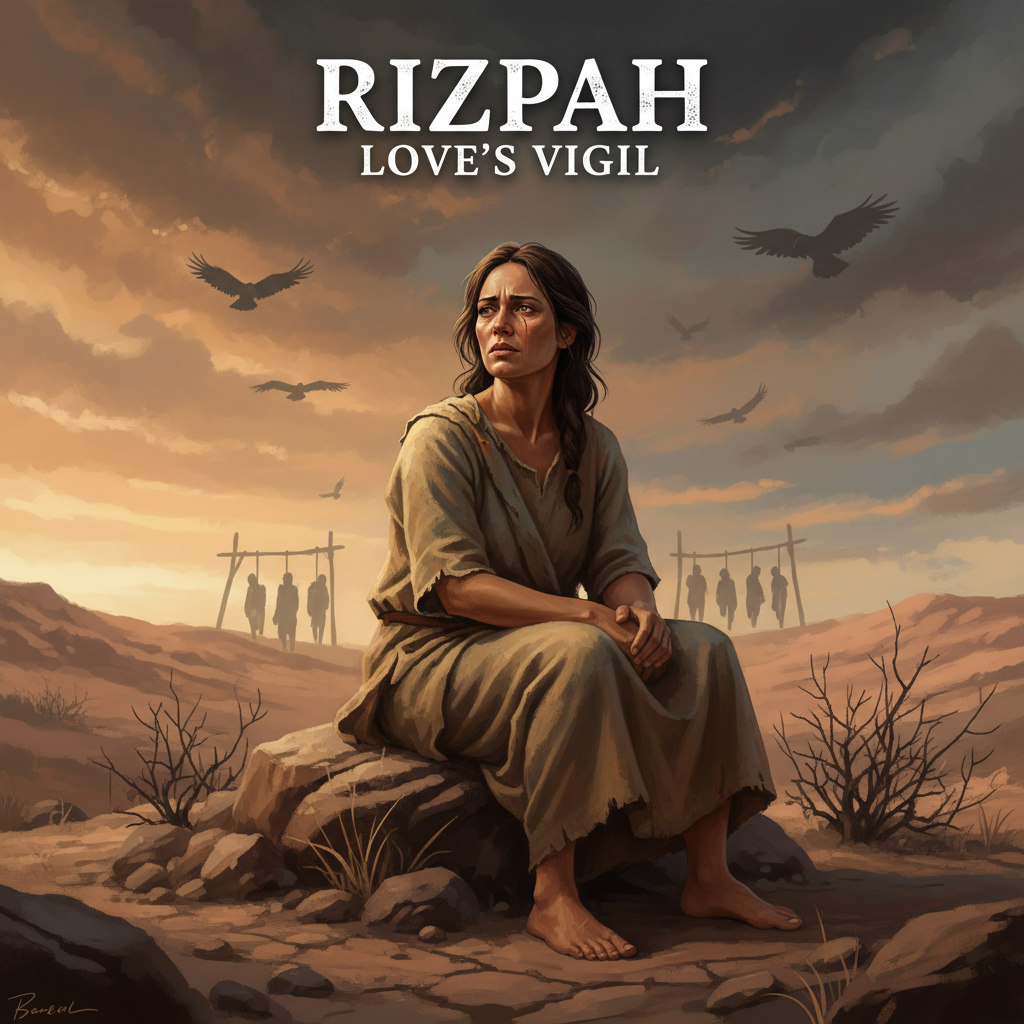
Rizpah guarding her sons’ bodies, preventing birds and beasts from eating their executed sons’ corpses for months, as told in 2 Samuel 21.
A mother’s devotion is one of the most intense stories in the entire Bible in 2 Samuel 21. There’s a severe famine in Israel for three long years. King David asks God for an answer, and God reveals the reason, Saul slaughtering the Gibeonites, a people protected by an ancient treaty. The Gibeonites want justice, so they execute seven descendants of Saul.
David spares Jonathan’s son Mephibosheth because of an old oath. Among the seven given over are two sons of Rizpah, Armoni and Mephibosheth (different from Jonathan’s son), plus five grandsons who are related to Saul through Saul’s daughter. Hanging these men from the hill in Gibeah at the start of the barley harvest is a deep dishonor in that culture.
As a daughter of Aiah and once a concubine of Saul, Rizpah steps into this horror with unbreakable resolve. She can’t stop the executions, she can’t bring her boys back, but she doesn’t want them abandoned or defiled. She spreads sackcloth on a rock and settles down right at the foot of the execution site. In the spring, from the beginning of harvest until the late rains fall in autumn, she stays put for months, maybe five or six.
Day after day, she drives away the birds that circle overhead, swooping to peck at the bodies. Night after night, she keeps wild animals from eating what remains of her sons and the others, drawn by the scent. As she watches over these lifeless forms, she eats little, sleeps little, endures the wind, and cold, all while protecting their dignity. Even in death, her silent vigil is a powerful act, a refusal to let injustice win.
As soon as David hears what Rizpah’s doing, he gets moved. This woman guards the bodies from scavengers day in and day out. He remembers the bones of Saul and Jonathan, still not properly buried after years, still held by the men of Jabesh Gilead. David gets inspired by her and gathers those bones, the seven executed men’s remains, and burys them all in the family tomb at Zela in Benjamin. It’s only then that God responds, the famine lifts, the rain returns, and the land is saved.
Rizpah’s story stands out for its raw emotion and quiet power. She doesn’t say anything, but her actions speak for her. In a time when bodies left unburied faced ultimate shame, she fights for their honor. Her perseverance forces a king to act, turning vengeance and neglect into a cycle of remembrance and restoration. She embodies a mother’s instinct to shield her children.
We’re reminded this isn’t a minor figure when the text repeatedly focuses on her name, Rizpah daughter of Aiah. In the end, her months of watching led to closure for Saul’s house and blessing for Israel, showing how steadfast love can change the course of events. In the end, her vigil bridges personal grief and national healing.
Love doesn’t always win quickly, but it endures, guards, and refuses to look away, even when the cost is so high. Rizpah’s example lingers as a testament to devotion that outlasts tragedy, a mother who, in her quiet strength, brought rain and renewal to a broken land.