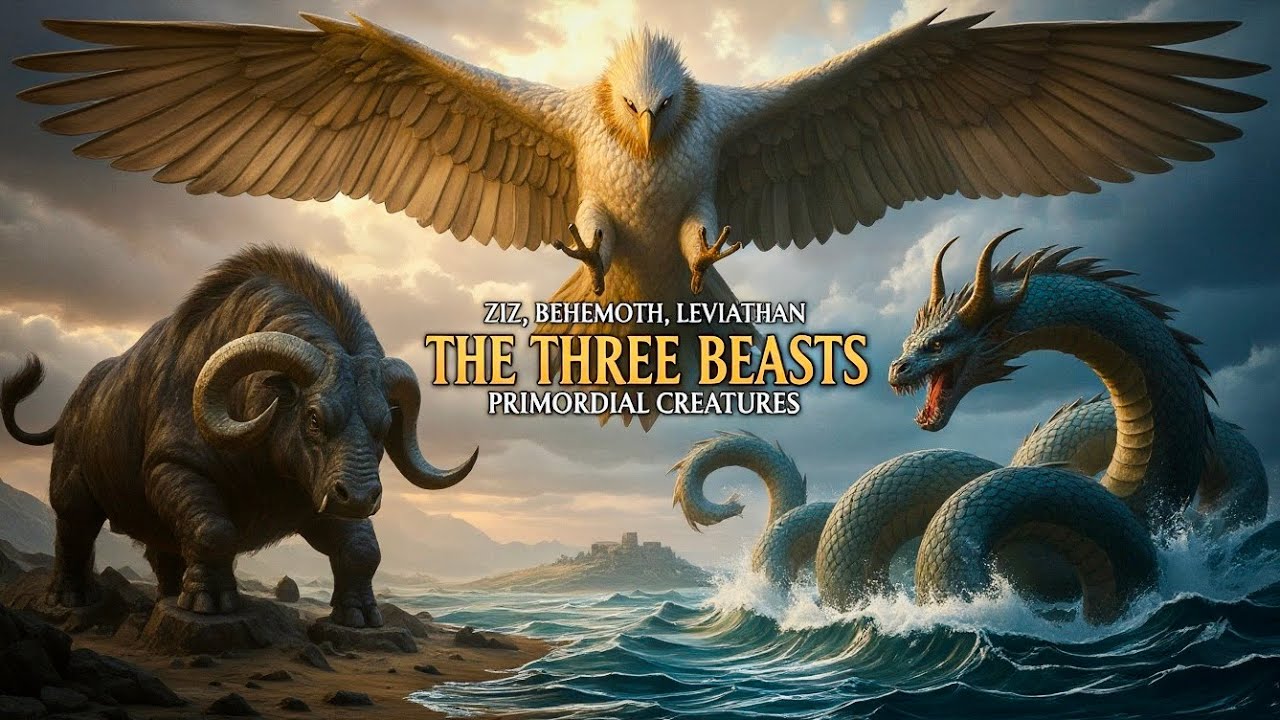
A Leviathan, a Behemoth, and a Ziz are these epic, massive creatures from Jewish mythology that represent the wild forces of the sea, land, and sky. They’re often described as primordial beasts created by God at the beginning, each ruling its own domain and displaying divine power.
The Leviathan is the unstoppable sea serpent, a dragon-like creature in the deep waters with scales you can’t pierce, eyes like dawn, and a mouth that’s full of rage. He’s mentioned in Job chapters 40 and 41, where God describes him to Job to emphasize that no one can tame or fight such a force, plus he’s described as chaos itself that God keeps in check in Psalms and Isaiah.
There’s also Behemoth in Job 40, this colossal land beast often pictured as a mighty ox or bull with a tail like a cedar tree, bronze bones, and strength like a mountain. As the king of all dry-land animals, he eats grass from a thousand hills.
Then there’s Ziz, the giant bird of the air, which isn’t named outright in the Bible as clearly as the others, but is derived from verses in Psalms 50 and 80 where “ziz sadai” means moving creature or wild thing in a field, which rabbis later turned into this enormous feathered giant whose wings blot out the sun and whose flight holds up the sky.
In later Jewish stories and midrash, these three get linked together as symbols of creation’s raw power, one for each element: water, earth, air. One of the coolest parts is the eschatological angle, in which at the messianic banquet for the righteous, God slays them and serves their flesh as this amazing feast, turning chaos into a blessing and showing that disorder has won out.
According to some stories, God made male and female versions on creation days five and six, but killed the females so they wouldn’t multiply and overwhelm the world, leaving the males.
Near Eastern myths like Babylonian chaos monsters and Persian giant animals influence Jewish tradition, but they’re reframed to emphasize God’s sovereignty instead. These beasts appear in texts like the Talmud, Book of Enoch, and kabbalistic writings, sometimes linked to bigger ideas about good versus evil or spiritual realms.
They’re reminders that the world is filled with huge, untamed energies, but they’re all under divine control, waiting for their big moment.