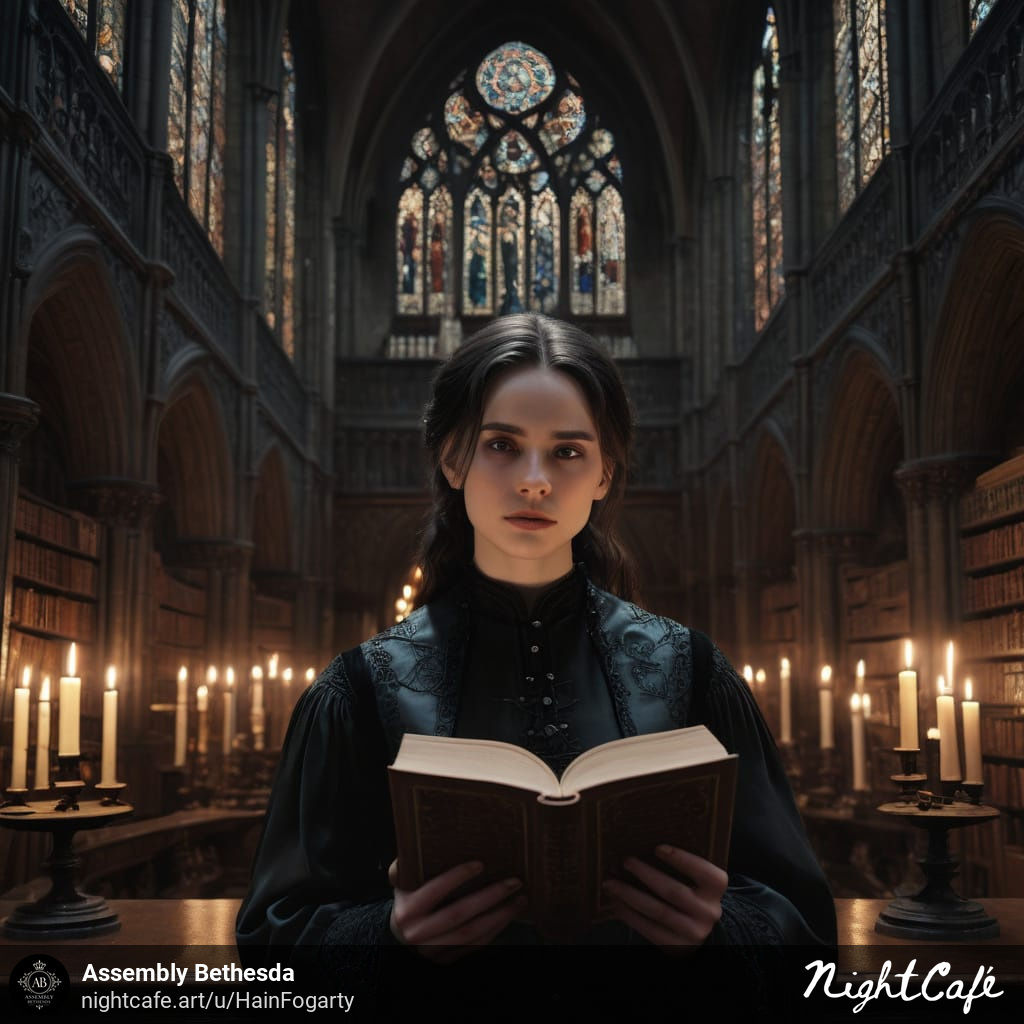
Let’s talk about two aesthetics that look a little alike, but came from totally different places. Both Dark Academia and Christian Goth love dark vibes, moody colors, and a touch of mystery, but dig a little deeper, and you’ll see they’re pulling in opposite directions. The one’s about chasing knowledge in old libraries with drama, and the other uses darkness to point you to salvation.
If you’ve ever wondered why some outfits feel intellectual and brooding while others feel spiritual and hopeful, this breakdown is for you.
I’ll start with Dark Academia, an aesthetic that exploded online a few years ago. It’s basically a love letter to classic education. There’s tweed blazers, crisp white shirts, plaid skirts and trousers, leather satchels stuffed with old books, and candlelight study sessions in Gothic buildings. Black isn’t just black for black’s sake, it’s black because it’s timeless and serious. It’s deep burgundies, forest greens, navy blues, and lots of black. Crunching leaves underfoot, foggy mornings on ivy-covered campuses, and the smell of old books.
Dark Academia is about intellectual pursuit. It’s about romanticizing the idea of studying ancient Greek philosophy, Latin poetry, Shakespeare, or dusty old books. There’s often a sense of obsession, secret societies, forbidden knowledge, and moral ambiguity mixed in. A person might post about late-night reading marathons, handwritten notes in calligraphy, or debating existential questions over coffee in this space.
There are a few nods to mythology and humanism in it, but it’s mostly secular. It’s dark, tragic, beautiful in decay, and a thrill to uncover hidden truths, even if they lead to obsession. It’s pretentious in a charming way, like you’re too smart for the modern world and you’d rather live in a 19th-century novel.
Now let’s look at Christian Goth. It’s a mix of classic Goth with a strong Christian foundation. During the late ’70s and early ’80s, goth started out as a music scene, like Bauhaus or Siouxsie and the Banshees, and people wore black clothes, dramatic makeup, lace, velvet, leather, and silver jewelry. These are the elements of Christian Goth, but they’re redirected to faith. The dark romanticism is mixed with crosses, crucifixes, rosaries, Bible verses, and saints instead of occult symbols.
The outfits could include long, black dresses with lace collars, black blouses buttoned up modestly, velvet capes, fishnet underneath modest skirts, heavy boots, and smoky makeup. Darkness isn’t glorified for its own sake, but is used to highlight light. The aesthetic leans into themes of mortality, suffering, sin, and grace.
In the Bible, it talks about walking through the valley of death without fear, or how Christ conquered darkness with the cross. Macabre imagery, like skulls and graveyards, reminds Christian Goths of life’s brevity and resurrection. It’s introspective and hopeful, using the same somber palette to express spiritual warfare, redemption, and God’s sovereignty over evil.
There’s a lot of overlap visually. Both love black, Gothic architecture, candles, and brooding atmospheres. You might see a black turtleneck and skirt in both aesthetics. But what’s important is the intent. An ironic crucifix might be used in a secret society ritual scene from a book in Dark Academia, but a Christian Goth might wear one as a statement.
While one aesthetic romanticizes forbidden knowledge that can lead to tragedy, the other uses darkness to emphasize good’s victory.
I’d like to talk about mood and philosophy. Dark Academia feels elite and exclusive, like you’re part of a club of thinkers who see the beauty in melancholy and intellectual danger. Stories like The Secret History and If We Were Villains show brilliant students spiraling into obsession and crime. Christian Goth, on the other hand, is about humility in the face of darkness. The vibe is tragic beauty.
It acknowledges sin and death head on, but points towards Christ’s redemption. Instead of glorifying the fall, it celebrates the rise. It’s less about being smarter than being saved.
The style of Dark Academia is preppy-academic with vintage twists: argyle sweaters, oxford shoes, signet rings, wool coats. The Christian Goth substyle draws more from traditional Goth substyles, like Romantic Goth, with flowing lace and corsets, but keeps it modest and faith-driven. A cross made from an ankh or an inverted cross reclaimed as a symbol of resurrection rather than rebellion could be an accessory.
Neither aesthetic rejects bright or positive culture. It’s worth looking at shadows, whether it’s ignorance (Dark Academia wants to banish it through education) or sin (Christian Goth wants to face it through faith). But Christian Goth goes further than Dark Academia to eternal hope, whereas Dark Academia stops at human achievement and aesthetic beauty.
In the end, if you’re into old books, classical music, and the romance of scholarly obsession, Dark Academia might be for you. Christian Goth is perfect for dark fashion that means something deeper, tied to Scripture and salvation. They can even blend a little, like wearing a tweed jacket with a cross necklace, but at their core, one worships the mind, the other worships the Maker.