
As the Bible says, “When a child is young, he won’t deviate from the path he should follow.” In a world where truth and cultural trends blur, incidents like the one involving California teacher Kristin Pitzen serve as stark reminders of the spiritual battles that are going on in our schools. This wasn’t just a viral video that got people talking, it was a glimpse into a society that was struggling. Prayerfully examine this story through the lens of Scripture, seeking wisdom to protect our kids’ faith and guide them to God’s unchanging will.
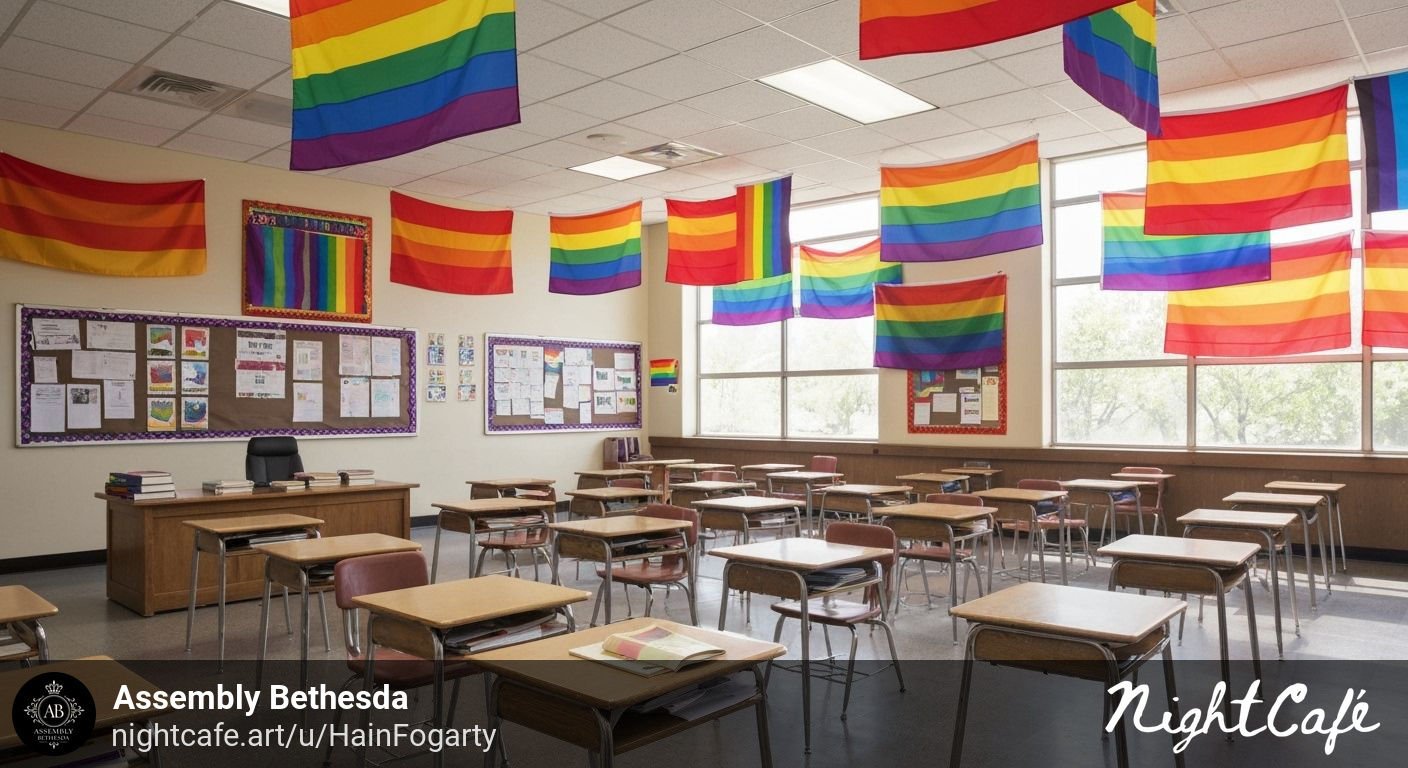
In Orange County, California, a high school English class isn’t adorned with the stars and stripes of the American flag, but with Pride flags. A teacher at Back Bay High School in Newport-Mesa Unified School District captured this scene on TikTok, but deleted it afterward.
During the clip, Pitzen pointed to a rainbow flag and said, “I pledge allegiance to the queer.” If the traditional Pledge to the American flag made you uncomfortable, she invited her students to do the same. She explained that she had removed the U.S. flag during the COVID-19 pandemic because it personally unsettled her, replacing it with symbols of pride that she deemed more fitting for her space.
This moment cries out for discernment. The Bible teaches that no man can serve two masters because he will either hate one and love the other, or be devoted to one and hate the other (Matthew 6:24).
Allegiance to a flag is one thing, a civic exercise rooted in gratitude for God’s gift of nation and liberty; but suggesting an alternative that promotes a worldview at odds with biblical truth is very troubling.
Even though the Pride flag is meant to be a banner of inclusion, it often represents ideologies that redefine God’s design for gender, sexuality, and family. This clashes with the fact that God made us both male and female in God’s image in Genesis 1:27. Whether we’re parents or church members, we have to ask: What message does this send to impressionable young hearts? We should make sure our kids know when cultural symbols shift from the cross to the rainbow.
The quick public outcry wasn’t surprising, and it echoed the righteous anger of people who value truth from a faith-filled viewpoint. Conservative voices on platforms like Fox News and social media decried Pitzen’s actions as indoctrination, a push to prioritize progressive agendas over patriotism and, by extension, the moral foundations that underpin our freedoms.
According to journalist Andy Ngo, the video calls for pledges to an LGBTQ BLM trans flag, which is divisive and opposes unity. Even international commentators, like British journalist Martin Daubney, hailed the school’s response as a win for common sense, warning against “brainwashing” kids with deceptive ideologies (2 Timothy 3:13).
In the middle of the storm, we see God’s sovereignty working. The Newport-Mesa Unified School District acted decisively, placing Pitzen on administrative leave by August 30, 2021, and beginning an investigation. They reaffirmed their commitment to respecting the American flag, a symbol that, for many Christians, points back to the providence of God in forming a nation where the Gospel could flourish freely.
Despite her social media presence being scrubbed clean by September, Pitzen’s words lingered in screenshots and reposts. This outcome reminds us of Ephesians 6:12, “We’re not fighting flesh and blood, but against rulers, authorities, cosmic powers over this present darkness.” There’s more at stake than just one teacher, there are principalities trying to erode biblical values where future generations are forming.
As an English teacher who’s passionate about diversity, Pizhen shared TikTok content celebrating Pride month, decorated her room with flags, and weaved themes of acceptance into her lessons. In a secular sense, this might seem harmless, even noble, but as Christians, we have to think about the consequences. According to Jesus, “beware of false prophets, who are sheep-like on the outside but ravenous on the inside.” Educators risk leading students astray from the path of righteousness when they introduce symbols that normalize sin, as defined by God’s unchanging Word. Despite California law mandating the display of the U.S. flag and patriotic exercises in public schools, participation remains voluntary, a nod to free speech. Although Pitzen’s suggestion was framed as an option, it could pressure vulnerable teens to conform to a narrative that contradicts the Gospel.
Brothers and sisters, this incident wasn’t an isolated incident. Schools nationwide struggled with integrating themes of identity and equity following 2020’s social upheavals, often at the expense of neutral, God-honoring education. A rainbow display became commonplace during the extended Pride season, which bled into back-to-school routines. From a biblical standpoint, this raises alarms about the subtle idolatry warned against in Exodus 20:3, “You shall have no other gods before me.” We see hearts drifting from our true source of identity when flags of human invention take precedence over symbols of divine order.
Thankfully, glimmers of hope emerged among the controversy. Students rallied, not for Pitzen’s approach, but for a balanced representation that honors all, including those who cherish national and spiritual heritage. Inadvertently, advocacy groups insisted that Christian voices rise, offering compassion without compromise, while sometimes defending queer educators. As Christians, we need to love the sinner while upholding truth, extending grace that points to redemption in Jesus (John 8:11), based on studies like the Trevor Project. However, there’s no ignoring the data that shows that visible biblical affirmation in schools makes students more resilient and purposeful.
Legally, the case stirred questions about free speech, but Scripture has clearer guidance. Teachers, as public servants, have limitations on their expression, much like we, as salt and light (Matthew 5:13-16), must speak truth in love without overstepping into coercion. By acting in a way that’s aligned with Romans 13:1-2’s call to submit to authority, the district likely avoided more legal entanglements.
In 2025, the Pitzen story still reverberates through online conversations, from X posts decrying ideological overreach to threads urging parents to reclaim education. It’s been linked to broader struggles, like students chanting patriotic pledges when Pride events are mandatory. As Christians, this calls us to action: advocate for policies that protect classrooms as places of learning, not proselyting; pray for educators like Pitzen, so their eyes might be opened to the light of Christ (2 Corinthians 4:4); and invest in our kids’ spiritual formation.
In closing, dear reader, let this be our pledge: allegiance to the King of Kings, whose banner over us is love (Song of Solomon 2:4). Kristin Pitzen’s situation shows how fragile earthly loyalties are and how strong eternity is. Hopefully it will spur us to be vigilant, compassionate, and unyielding, so that the next generation can serve God. Hold on, church, because victory is assured in the Lord.
So I am using this image because It killed me when it rendered The entire prompt was “Pride flag in classroom” Boy did AI not disappoint.
So I am using this image because It killed me when it rendered The entire prompt was “Pride flag in classroom” Boy did AI not disappoint.