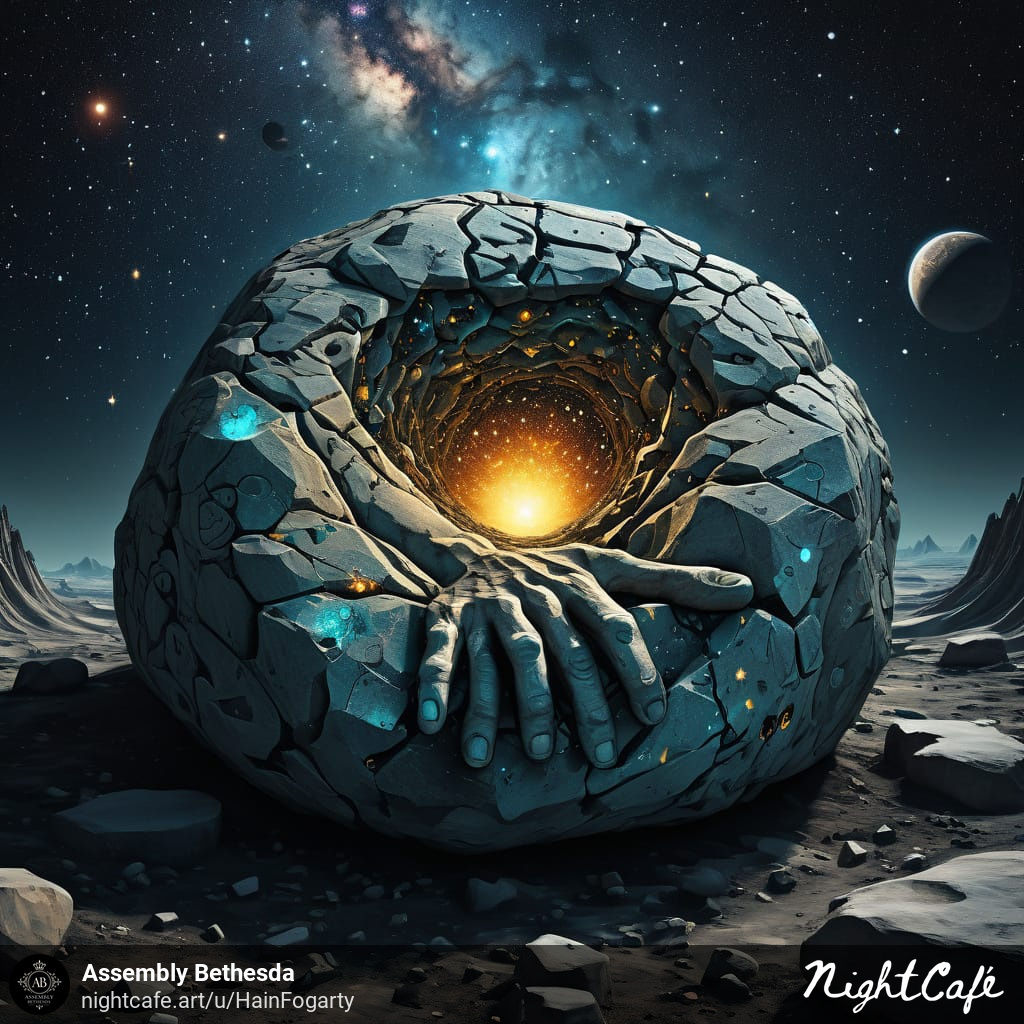
While flipping through a bunch of nothing to watch, I heard someone ask the question. “Can God create a rock he can’t lift?” Of course it was asked to “stump the preacher.” So today, we’re going all the way down this rabbit hole.
Do you ever wonder whether an all-powerful being could create something beyond its own abilities, as a question that seems to twist your mind into knots? For centuries, the classic riddle has echoed throughout philosophical debates, challenging our understanding of power, logic, and divinity by challenging our understanding of a rock so heavy that it cannot be lifted.
Although this query is often tossed around casually or in heated theological discussions, it probes deeply into the nature of omnipotence, despite its apparent simplicity. During this exploration, we will examine why this question arises, why it represents a logical fallacy, and how scholars have responded over time. At the end of this discussion, you may find that what appears to be a clever trap reveals more about human reasoning than about divine limitations.
The question comes from a long tradition of paradoxes designed to test the boundaries of concepts we take for granted. It goes back to medieval philosophy, but similar ideas appear in ancient texts as well. For instance, in the 12th century, thinkers like Averroes and Thomas Aquinas grappled with notions of infinite power, but the stone paradox is usually attributed to later discussions, perhaps inspired by earlier dilemmas like the liar paradox from Epimenides.
Why does this particular question persist? We’re curious about absolutes. In a world full of limitations, the idea of an unlimited entity fascinates us, and we naturally want to poke holes in it. It’s sometimes used by atheists to get around theistic belief, saying that God should be omnipotent if He could make an unliftable rock, so He can’t lift it if He can create it. Either way, omnipotence leads to contradiction, suggesting that no such being can exist.
Theists, on the other hand, see it as a prompt to dig deeper into their understanding of God. We tend to anthropomorphize the divine by picturing God wrestling with physical rocks like some cosmic weightlifter, but the question goes beyond debate fodder.
Let’s figure out why this riddle doesn’t work. The problem is a self-referential inconsistency in terms at its core. The paradox relies on a particular interpretation of omnipotence, assuming it means doing anything, no matter how ridiculous or contradictory it is. But logic itself imposes limitations. What is the question really asking? Can an all-powerful being do something logically impossible? It’s like asking if God can make a square circle or a married bachelor.
These aren’t real possibilities. They’re linguistic tricks combining incompatible properties. It’s called an equivocation fallacy, in which omnipotence is subtly redefined from “able to do all possible things” to “able to do impossible things.” A classical definition of omnipotence doesn’t mean violating logic laws, because logic laws aren’t just random rules, they’re fundamental truths. Would God do the Illogical?
That’s like asking an expert mathematician to solve an equation that equals two and three at the same time. It’s not the mathematician’s fault, it’s the equation.
In addition, the paradox presents just two options, both of which lead to failure, without taking into account the third option: that it’s nonsensical and doesn’t impinge on real power. Even when we talk about God, nonsense remains nonsense, according to philosophers like C.S. Lewis.
A rock that’s so heavy it can’t be lifted by an omnipotent being can’t be created by that same being, because creation implies the ability to manipulate it. In many theistic traditions, God isn’t bound by gravity or mass, so this creates a loop of contradiction, but it’s artificial, built on flawed premises. Another angle reveals a category mistake: God isn’t a physical entity. If you show Him lifting a rock, you anthropomorphize a transcendent being.
A rational theology doesn’t constrain God, it just expresses His nature. The question doesn’t disprove omnipotence, but just shows the limits of human language and imagination when describing it. If God’s the source of logic, He can’t contradict Himself without undermining existence.
Theology, philosophy, and modern logic have all been used to enrich the discourse on this paradox. In his Summa Theologica, Thomas Aquinas, a Dominican friar from the 13th century, argued that God’s omnipotence includes everything that’s possible, not absurdities. For Aquinas, power is about actualizing potentials, not resolving contradictions.
The unliftable rock isn’t a failure of God, but a non-entity. “Whatever implies a contradiction can’t be a word,” he wrote, pointing out that such impossibilities aren’t things at all. A rationalist in the 17th century, René Descartes, argued that God could do things that are logically impossible, because His will precedes logic. According to Descartes, eternal truths like mathematics are determined by God, so He can alter them.
But this voluntarism risks making God arbitrary, which critics like Leibniz argued undermines rationality.
Averroes (Ibn Rushd) echoed Aquinas in Islamic philosophy by distinguishing between essential impossibilities and contingent ones. He said God’s power was infinite but aligned with wisdom and order. Maimonides rejected anthropomorphic interpretations too, arguing the paradox was a misinterpretation of God’s incorporeal nature. Modern scholars build on these foundations. The rock scenario isn’t a possible state of affairs, so it doesn’t count against God.
Alvin Plantinga, a contemporary Christian philosopher, reframes omnipotence as the ability to actualize any possible state of affairs. According to William Lane Craig, the paradox assumes a naive view of power, ignoring the fact that true omnipotence involves maximal excellence. Philosophers like J.L.
Mackie have used it to argue against theism, but even they acknowledge it’s more of a puzzle than a knockout blow, since redefinitions of omnipotence can sidestep it.
Scholars like Mary Daly offer fresh perspectives on the paradox. They critique it for its patriarchal imagery of God lifting muscles, suggesting it perpetuates gendered notions of power. Process theology suggests God’s power is persuasive, not coercive, so the rock doesn’t matter.
The statement “There exists a rock that God cannot lift” leads to contradictions in possible worlds where God is omnipotent. Hence, no such world exists, preserving coherence.
We reveal more about our finite minds than about God’s infinite reality, which is the point of the omnipotence paradox. It doesn’t diminish the divine, it elevates our understanding of it and Jesus. This riddle encourages humility in the face of the unknown, whether you’re a believer trying to strengthen your faith or a skeptic probing assumptions.