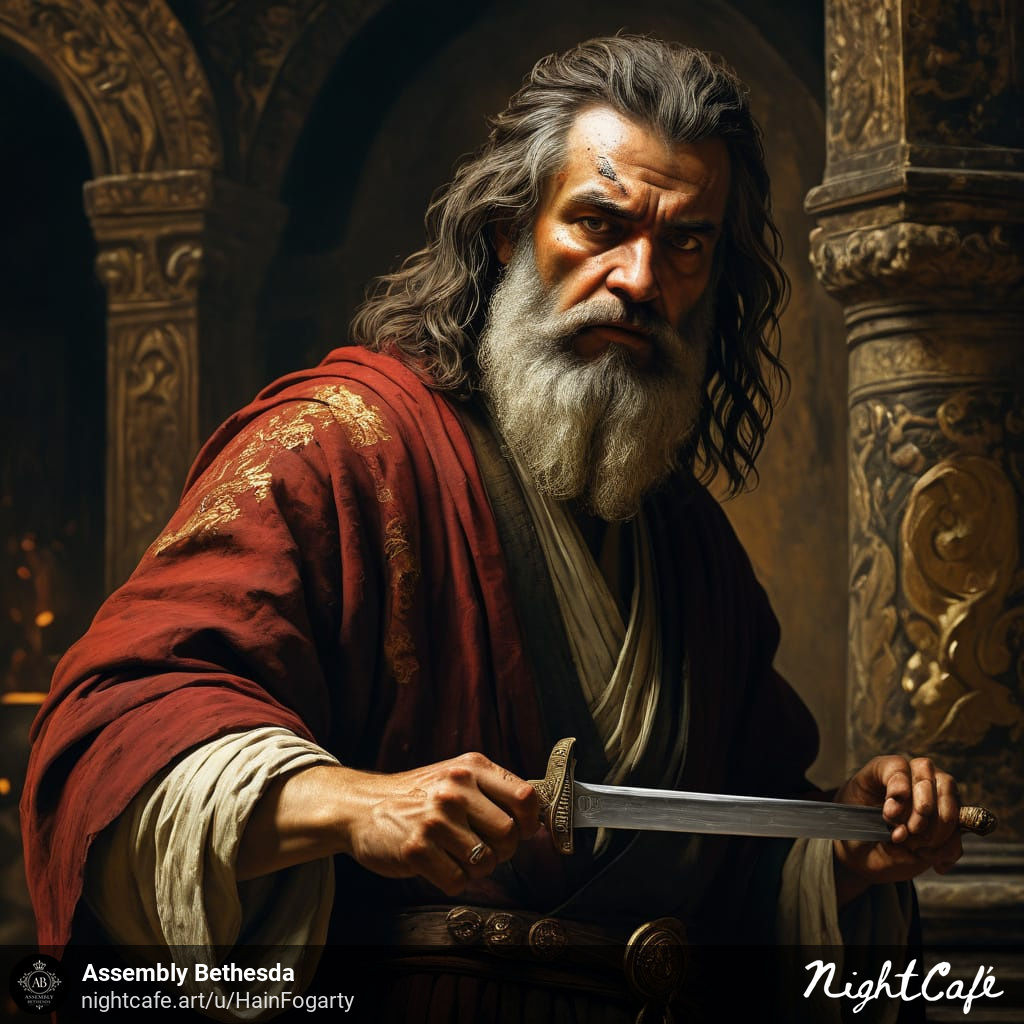
This is one of the most dramatic and gritty stories in the Bible: Ehud kills Eglon, the Moabite king, in Judges 3:12-30. While revealing the moral complexities of Israel’s turbulent era, it showcases Ehud’s courage, cunning, and divine empowerment. It’s a thrilling tale of liberation, but it also makes you think about God’s sovereignty, human agency, and violence ethics.
The Book of Judges shows Israel’s cycle: sin leads to oppression from foreign powers, cries to God lead to deliverance through a judge, followed by temporary peace. As a result of Israel’s idolatry, Moabite domination lasted 18 years during Eglon’s reign. Moab’s king, Eglon, formed alliances with the Ammonites and Amalekites, seizing Jericho and imposing heavy tribute. Ehud, a Benjamite warrior chosen by God to free his people, steps into this oppression.
In Ehud’s introduction, he’s described as left-handed, literally “restricted in his right hand,” a rarity that makes him perfect for surprise attacks. His physical distinction, combined with his boldness and strategic mind, made him the perfect candidate for his mission. The narrative explicitly states that God raised him up, underscoring that his actions served a divine purpose.
As part of his preparation, Ehud made a double-edged dagger, longer than standard, and strapped it to his right thigh, a spot guards overlooked when they checked his left side for weapons. Ehud got into Eglon’s presence by posing as a tribute-bearer. He claimed he had a secret message from God, prompting him to dismiss his attendants.
In that private moment, Ehud struck, plunging the dagger into Eglon with such force that the blade vanished into the king’s fat, with the handle disappearing completely. When Eglon’s servants mistook his condition for a private moment, Ehud escaped through a sewer after locking the doors.
A description of Eglon as “very fat” symbolizes wealth and power in the ancient Near East. Yet this physical trait led to his demise, which wrapped around Ehud’s blade. His 18-year tyranny marked him as an enemy of God’s people, but his overconfidence ended his life. Seeing Ehud alone revealed a vulnerability underneath his imposing exterior.
Ehud’s success proves God’s sovereignty. The story illustrates God’s power over Israel’s enemies, regardless of their strength. It fits Judges’ broader theme: God delivers His people through unconventional means when they cry out. It’s hard to decide how ethical Ehud’s assassination is. In context, Eglon’s oppression justified the action, since Ehud was God’s appointed deliverer in an era without formal justice systems.
A warrior ethos aligned with assassinating enemy kings in ancient Near East. Modern readers might see it as murder or terrorism because of the deception and graphic violence. In a fallen world, the story challenges believers to navigate moral complexity.
As Eglon’s fat swallows the dagger, his servants delay entry, thinking he’s “covering his feet,” which is a euphemism for defecating. Ehud escapes the king’s private chamber, turning it into his downfall. Throughout the story, God uses the weak to shame the strong, echoing 1 Corinthians 1:27.
The structure builds suspense effectively. Verses 3:12-14 explain the oppression, 3:15-22 describe Ehud’s preparation, 3:22-26 describe the assassination, 3:27-30 resolve with victory. Despite its vivid imagery and fast pace, it’s unforgettable. After the assassination, Ehud rallied Israel to kill 10,000 Moabites at the Jordan fords, securing 80 years of peace. He restored faith and freedom, at least temporarily.
He frees Israel from oppression, just like Christ frees humanity from sin and death. His hidden dagger reminds me of the cross, which looks weak but kills evil. Christ’s descent to the grave and resurrection mirrors Ehud’s lowly escape.
This narrative offers timeless applications. It teaches trust in God’s deliverance, often through unexpected people and methods. The moral complexity reminds readers that confronting evil requires wisdom. The humor shows God’s creativity in achieving His purposes. It’s up to believers to stand up against evil boldly when called.
In his assassination of Eglon, Ehud masterfully blends divine providence, human courage, and cultural realism. Ehud emerges as a flawed but effective deliverer, while Eglon embodies earthly power’s hubris. Through unconventional or morally complex means, readers are challenged to trust God’s sovereignty. It’s a testament to God’s faithfulness in liberating His people.